Here's the latest from Corymbia Biodiversity Project & Banyula Conservation Reserve…
This update looks back over a long hot summer at Banyula. Despite the heat, and the humidity, we are still working on a range of fronts to help its non-human inhabitants thrive and to prepare the property for what may lie ahead. There’s plenty of interesting footage to share from our cameras and from the wider area as part of a local Koala study backed by Corymbia project and a consortium of Koala conservation interests. We are pleased to report that Emus are still living among us, we are thinking about feral ferns, and we are skilling up to deal better with fire.
🌿 Let’s cool off and dive in. |
|
|
|
|
HR NEEDS HRWe reported late last year that we completed our first hazard reduction burn in partnership with the NSW Rural Fire Service and the Nature Conservation Council’s Hotspots program. Around 50 fire fighters and a dozen trucks from all around the local district were involved and the success of this effort was acknowledged by all.
Since then it has been agreed to keep the momentum going and we now aim to run a second HR burn in 2026. This will again provide the opportunity to offer hands-on training for newer RFS members.
Speaking of which, some of the newest human resources to join the local brigade are Banyula’s own Tony and Ken, who completed their RFS training in the past few months, including that training on Banyula. It is invaluable to the property and its management that we now have the benefit of this training accreditation in house. |
|
|
 Hear what Tony and Ken have to say about it. Hear what Tony and Ken have to say about it.
|
|
|
|
|
|
SUMMER TRACK & WEED WORK As all landowners know, some tasks are endless and you have to keep working away at them or get far far behind.
Track work is a never ending activity because tracks are so important for property management and extremely important for implementing and defending against fire. Before the next big rains come, Ken has been working with his trusty tractor on some key areas to ensure adequate drainage is in place that will help to protect the tracks from erosion and to help keep sediment from moving into our local waterways. |
|
|
| | KEN’S REPORTHad a good break from the wet weather over the summer. It has allowed for great progress on track maintenance and fence prep to mitigate potential fire risk. Looking forward to a hopefully calm lead up to winter weatherwise. Will let you know if it snows! — KEN - Banyula Operations Manager |
|
| | Meantime, the weed team (Banyula Bobcats) have not rested over the summer. They have however, been working smart, setting aside for now the primary or first treatment work (green fill), instead focusing on follow up or secondary work in targeted areas (red fill). Follow up is critical and a lot less arduous in the heat and humidity. When it finally cools down, we will resume primary work in the final 10% of truly untouched areas (no fill area). An ongoing rotational follow up work program, largely around the creekbanks, will then keep us busy for some time to come. |
|
|
|
|
|
|
|
|
|
|
|
|
|
JEN HITS THE ROADNewsletters don’t just write themselves! This is what we are learning now that Jen has made the important decision that she needed to hit the road to do some courses and some long anticipated European travelling. It’s a blow for us, but we really appreciate all she has done with us and for us to now. She has helped to build a great network around Banyula and kept the world informed about our activities. And it has been fun! She will be missed. |
|
|
| JEN SAYS FAREWELL I’m heading overseas for my 50th year and am excited to explore Spain, Italy, Iceland and Sri Lanka (and many more), painting and immersing myself in nature along the way. I’ve had such a rewarding and meaningful time helping gather community around Banyula over the past 4 years and look forward to immersing in conservation and community projects abroad. Thanks so much 💛 — JEN - Banyula Communications and Outreach |
|
|
|
|
|
|
|
|
|
|
|
|
Being our key outreach and communications person, we have had to reassign the task of preparing newsletters, blogs and videos. Luckily, Adrian has had quite some experience in this before, so we hope that the transition is smooth and ongoing engagement is effective. |
|
|
|
|
|
|
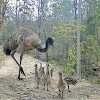
It’s a little voyeuristic perhaps. And we do hate to gossip! But with our property wide camera network, it’s just hard not to notice some things. A pair of coastal emu have been cruising in and around Banyula over Summer. We are very hopeful they are male and female and that just maybe they are pair bonding leading into the breeding season. After all, we have had a father and chicks successfully breeding in or around Banyula for the past few years. But we just do not know. Fingers crossed and hoping for the best. |
|
|
|
|
|
|
|
More good news on the avian front is the sighting of a White-Throated Nightjar chick (only their mothers could love them!), plus the frequent sighting of 2 pairs of Glossy Black Cockatoos, one with a juvenile.
And while we will take it as a positive that a pair of Torresian crows had success raising a chick near the house area, it was lovely until singing lessons started. |
|
|
|
|
|
FERAL FERNS IN THE CLARENCE |
|
|
|
The Clarence Valley has many native ferns, but few might realise that introduced ferns are establishing as part of the weed flora in the catchment!
Clive Barker - a regular Banyula weed whacker and ecologist at large - has been noticing some of the places four different species have been establishing during his bush regeneration and botanical work. Including on Banyula!
In response, Clive has prepared a brief overview of feral fernage of the Clarence Valley. Many thanks to Clive for his keen eye, huge knowledge base, and desire to share this important information more broadly. |
|
|
|
|
THERMAL DRONE SURVEY COMPLETE |
|
|
With support from a range of government and community partners, SMT Ecology was commissioned by Corymbia Biodiversity Project to survey 1000 hectares of potential Koala habitat in Pillar Valley using thermal drones (details here).
Sadly, we did not find any Koalas. But happily we did spy some other awesome creatures in the tree tops and on the ground, including nationally listed endangered gliders, snoozy snakes and unfortunately, pigs.
Visit our Youtube channel to see a video compilation of cool critters in action. Thanks to SMT Ecology for the footage. |
|
|
| |
|
|
|
|
|
|
|
|
|
|
|
SAFE HAVENS WRAPS UPBanyula has been part of the Nature Conservation Council’s (NCC) Large Forest Owls and Safe Havens projects since their early days. This has seen us hosting interesting workshops about owls and their prey species, and learning about habitat protection and restoration for these key faunal groups as part of maintaining healthy ecosystems.
Like a number of other local landholders in the project area, our involvement has also meant that we have been the recipients of a range of nest boxes, installed to ensure that both owls and their prey species have more access to habitat elements, to increase and expand habitat values. These have been monitored since installation by NCC and showed significant use by these (and a few other) species.
As well as raising awareness about the significance of owls in the landscape through the production of videos and booklets about key local threatened owl species, the project has been a big success.
But as we all know, all good things (based on grants, donations and other discretionary funds) come to an end. As such the NCC project team will run a final project wrap up and thankyou workshop at Banyula for participants in coming months. |
|
|
|
|
|
|
EOI: FREE MAPPING TOOLS ANYONE?Something we have been kicking around for long time is the idea of running some community workshops about free mapping tools anyone can use on computers and smartphones to better manage their properties, or in their citizen science capacity. For example, recording species, mapping weed infestations, planning areas of work, tracking and reporting works done, mapping tracks, gates and other property assets, preparing simple maps to share with others… |
|
|
We use a combination of Google Earth Pro and Avenza Maps all the time for a great number of purposes, with great effect. These tools can be used separately, or integrated to work in combination. |
|
|
|
For more complex and detailed work, we use QGIS which is a full blown geographic information system that allows for the use of complex environmental data sets available from numerous sources (such as SEED Portal) and the preparation of complex maps for a range of purposes. |
|
|
If you have an interest in learning about how you can use these tools yourself, we’d like to know about it. If there is enough interest, we will set up a half day workshop in Autumn covering the basics and some advanced uses of Google Earth Pro and Avenza Maps. We can also introduce QGIS if there is enough interest, or run a second workshop. |
|
|
|
|
|
|
Looking for a venue to study nature, facilitate meetings, or host a workshop?
The facilities at the Banyula Conservation Reserve are available for use in the name of science, education, or community events based around the natural environment. These include our fully equipped large shed with toilets and bathrooms, perfect for workshops, as well as our extensive walking tracks, feral-free area, and close proximity to the Yuraygir National Park and Solitary Islands Marine Park.
We encourage everyone to take advantage of these resources to foster learning, research, and community engagement in the natural environment.
Checkout the Banyula webpage and fill in the form at the bottom to host an event. |
|
|
|
|
WAS THIS EMAIL FORWARDED TO YOU?Join the Friends of Banyula mailing list to receive inspiring good news stories, invites to events, and updates on activities organised by us and other like-minded organisations and individuals. Stay connected and be part of our mission to protect and preserve our natural world! |
|
| |
|
|
|
|
|
|
|
|
|
|
|
|