Feral Ferns in the Clarence Valley
The Clarence Valley has many native ferns, but few realise that introduced ferns are establishing as part of the weed flora in the catchment! Clive Barker - regular Banyula weed whacker and ecologist at large - has prepared this overview of the feral fernage of the Clarence Valley.
Ferns don't have seeds as such but spores; minute seed equivalents, like the finest dust, they are easily dispersed long distances in the wind, by water movement or in mud etc. Easy dispersal means if they can establish, they probably will establish widely. Below are three fern species I have seen in the Clarence Valley that deserve our attention.
Green Cliff Brake
Green cliff brake (Pellaea viridis) has been found scattered in natural regrowth Dry Sclerophyll Forest on Banyula and is likely to be on nearby private lands, Candole State Forest and beyond. There is a denser population on the outskirts of Coutt's Crossing along a sheltered ditch line and it could be more widespread in the Clarence Valley. On the drier slopes of Banyula the native Cheilanthes can look similar, but its leaflets are much smaller. Native Pellaea's fronds usually look different, having have less complex leaflets.
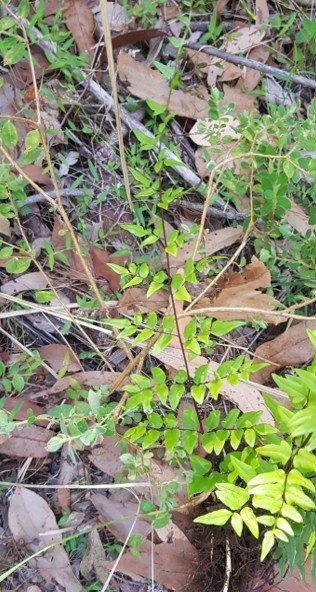
Green cliff brake (Pellaea viridis) [Photo Clive Barker]
Gold-Foot-Fern
The giant of local feral fernage is the gold-foot fern (Phlebodium aureum). I have seen it growing along a fallen paperbark trunk in Swamp Sclerophyll Forest (a Threatened Ecological Community) in Pillar Valley and in littoral rainforest (another TEC) on coastal dunes further north.
In its native South American habitat it grows on branches of rainforest trees, so it could also be established in other micro-habitats on the North Coast of NSW.
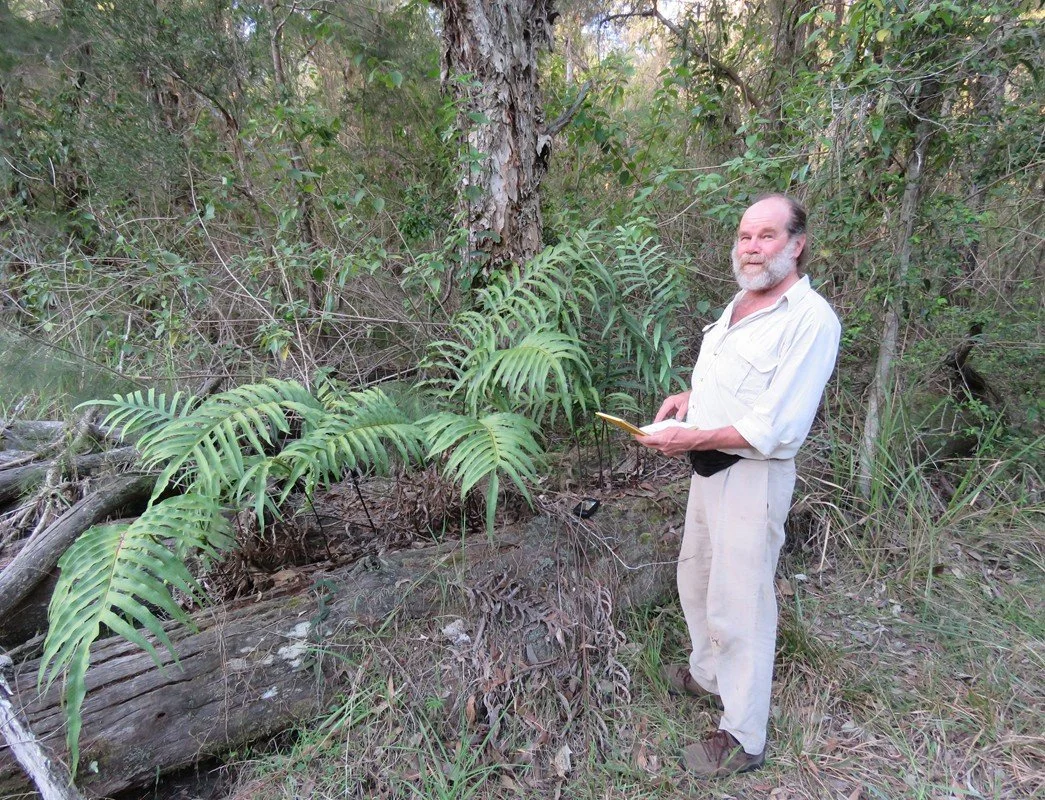
Clive Barker documenting first feral gold-foot fern (Phlebodium aureum) in the Clarence Valley [Photo Adrian Mowbray]
Gold Fern
Gold fern (Pityograma calomelanos var. austroamericana) so far (in the Clarence) found in few remote sandstone overhangs south of Shannondale; but more common in new habitat created for the Pacific Motorway bridge embankments which use stabilised batters coated with imported rocks. These artificial 'scree' slopes are probably helping the spread of this weed into remote sandstone overhangs. As the spores have less distance to fly from these new populations through the landscape, I suspect there are populations in other rocky natural country.
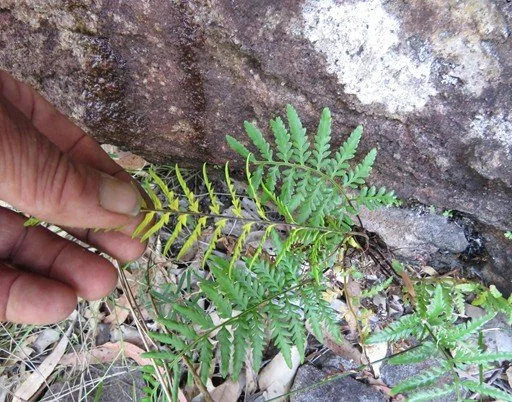
Gold fern (Pityograma calomelanos var. austroamericana); the gold is on the under-side of the fronds [photo Clive Barker].
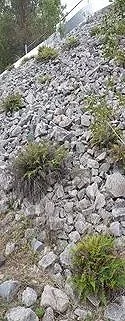
Gold fern (Pityograma calomelanos var. austroamericana); suitable artificial habitat helps this weed to spread into natural habitats [Photo Clive Barker]
Feral ferns have arrived! What are we to do?
Feral ferns have arrived in the Clarence Catchment and more will as other ferny ferals of NSW and Queensland spread… But what can we do?
Important: As good bush regenerators know, before removing suspect feral ferns their identity must be assured beyond doubt!
If verified as an invasive fern, the whole plant, should be removed and disposed of or burnt in a hot fire to kill the spores.
More importantly: Please don’t grow non-native ferns in your area!