Frogs are particularly sensitive animals that depend to a large extent on the availability of clean water for feeding, breeding and habitat. For this reason their presence (or absence) makes them very important ‘indicator’ species for the health of our ecosystems broadly. As they mostly live in the lower reaches of our water catchments, tracking frogs to learn about their situation over time means we can learn a lot about the broader catchment as well.
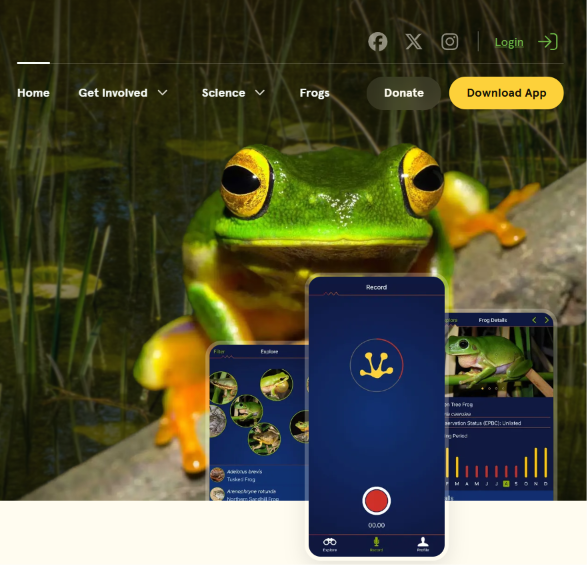
The Frog ID app is brilliant
The Australian Museum’s Frog ID app is brilliant for doing this. Not just because it helps you learn about and identify frogs in your area or wherever you are in Australia, but also because by using it, you are helping the museum build a picture of amphibian fauna, now, and over time. As the Museum says:
The FrogID dataset has already supported more than 30 scientific papers authored by Australian Museum scientists, helping advance understanding into frog distributions, ecology, inform conservation assessments and even help describe species as new to science. But its impact extends well beyond our own research team at the Australian Museum. Scientists, land managers and conservation practitioners from across Australia and beyond use FrogID data to inform biodiversity monitoring and make better-informed conservation decisions.
So Banyula decided to participate in this year’s annual citizen science Frog ID week in November. This let us contribute to these national efforts but also set up an easy way to document our own amphibian biodiversity.
Using the Frog ID app, we sent Clive out to 12 key locations around the property to record 20 seconds or more of calls over three different nights. Choosing the wetter nights maximised the ability to hear and record frogs. Clive detected (heard and/or saw) at least 11 species, some of which were not calling. The audio recordings made with the app are submitted to the Australian Museum to be identified as well, so in a few weeks we should also learn what the frog experts heard and we can tally it up.
Repeating this exercise every year at the same time will help to build a picture of frog presence and absence over time. Recording at other times of year may be worthwhile as well, since different frogs favour different times for calling.
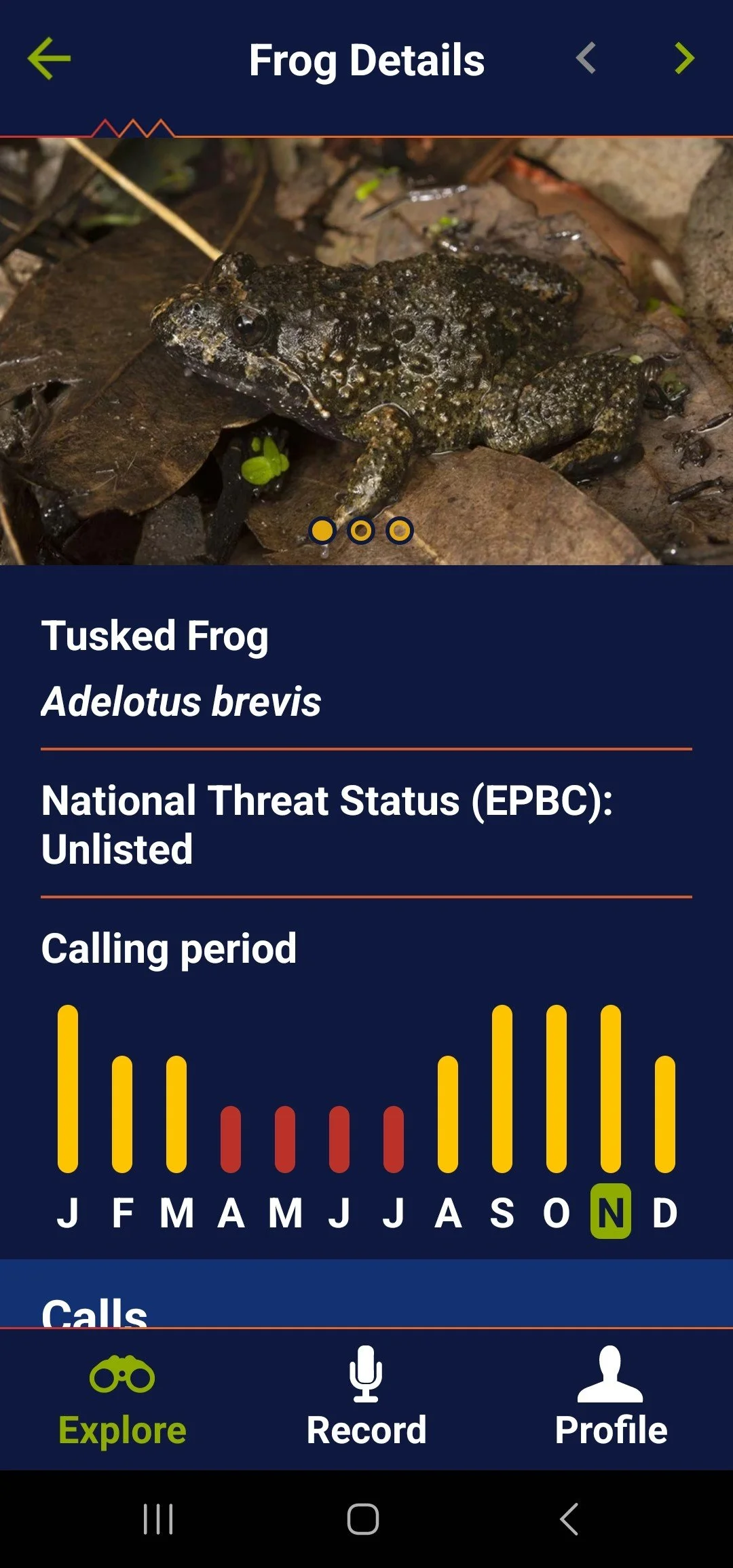
The Tusked Frog (Adelotus brevis), found at Banyula, calls from August through to March.
While Clive and Tony were returning from one of their sites, they almost stepped on a snake. Clive almost jumped out of his skin! Not from fear, but because the snake was a rare Stephen’s Banded Snake (Hoplocephalus stephensii), a threatened species! A most fortuitous find (read species Profile).
Stephens' Banded Snake is a distinctly banded, medium-sized partly tree-dwelling snake up to a metre long. It lives on the coast and ranges between Southern Queensland to Gosford in NSW in rainforest and eucalypt forests with rocky areas, to 950 m altitude. Fully nocturnal, it shelters in loose bark and tree trunks, among vines, hollow limbs or rock crevices or slabs by day. It hunts small mammals, birds, lizards and yes, frogs.
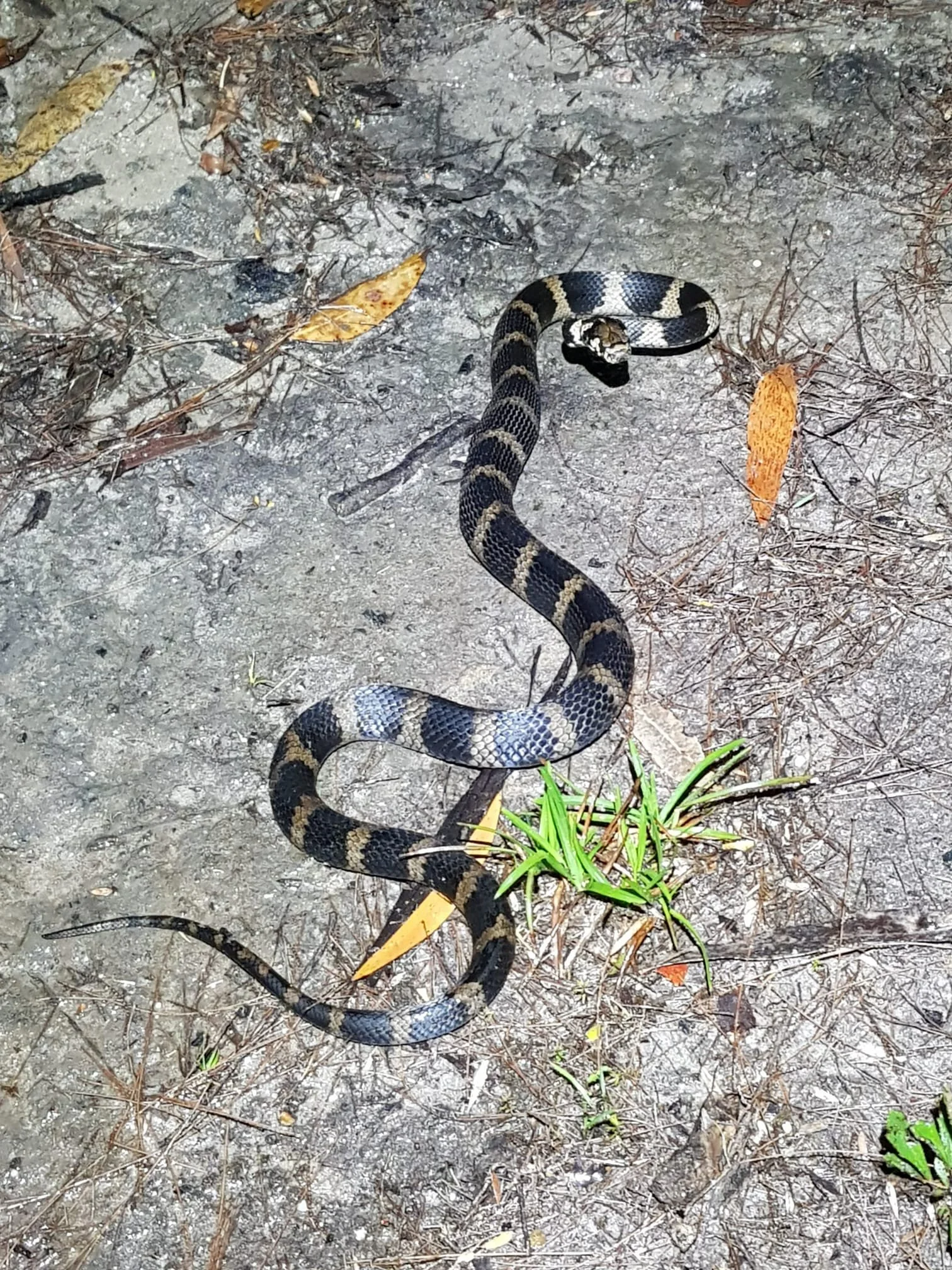
Stephen’s Banded Snake, listed as Vulnerable in the NSW BC Act, is a pretty rare find in the Clarence Valley
Thanks Clive for bringing your enthusiasm and knowledge to our efforts to learn and manage for conservation in our neck of the woods.